Taputapuatea Marae: Discover Polynesia’s Sacred Birthplace

09/22/2026
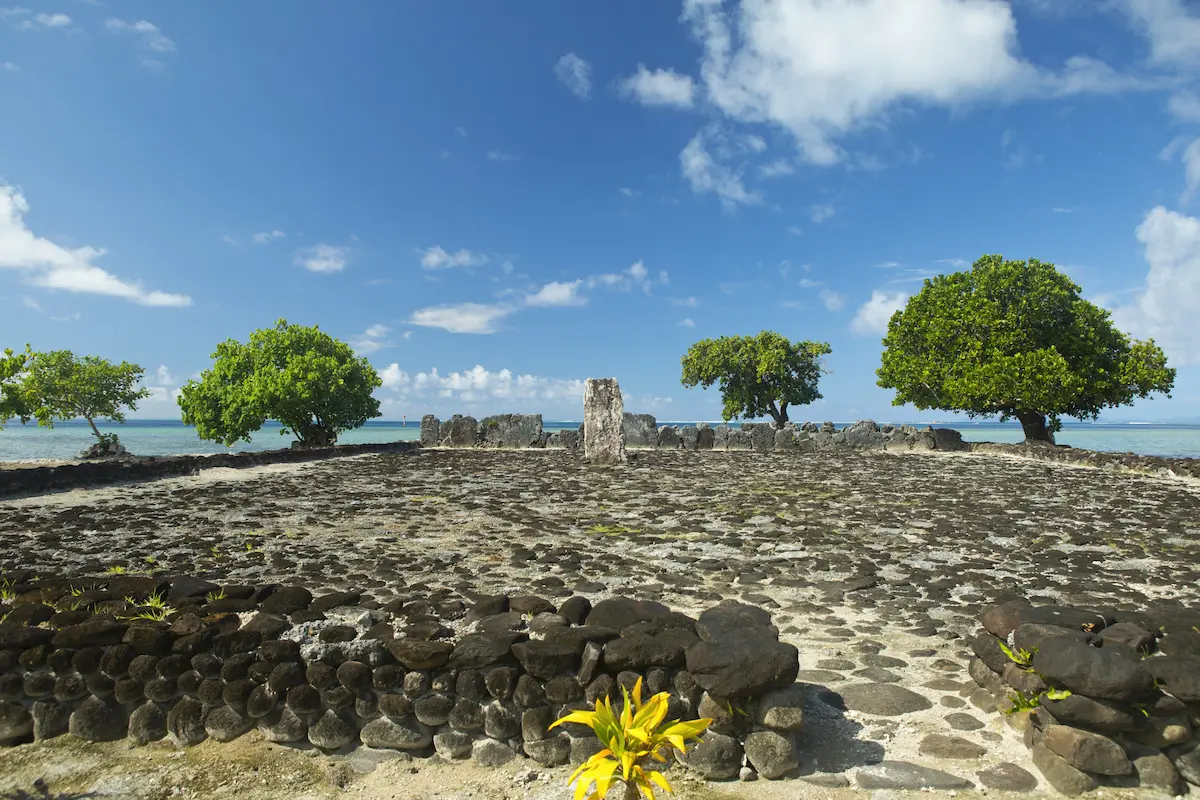
On the south-east coast of Raiatea, at Opoa, a low platform of dark stone faces the reef pass of Te Ava Mo'a.
The place looks almost bare. Nothing announces that for centuries, voyaging canoes from Hawaii, Rarotonga and Aotearoa crossed that pass to land here.
Taputapuatea Marae gives nothing away at first glance. You have to know what happened here to understand why all of Polynesia still calls it the point of origin.
What is Taputapuatea Marae ?
Before looking at the stones and the ceremonies, it helps to establish what this place is and why it stands apart across the whole Pacific.
Taputapuatea Marae is the largest and most important open-air sacred site in Polynesia. Located at Opoa on the island of Raiatea, it served as the religious, political and funerary centre of the mā'ohi world from the 14th to the 18th century, and as the gathering place for chiefs and priests from across the Polynesian Triangle.
It has been inscribed on the UNESCO World Heritage List since 9 July 2017, as a cultural landscape.
What is a marae ?
The word describes a sacred open-air space, not a roofed temple in the Western sense.
A marae combines a paved rectangular courtyard, where assemblies were held, with an ahu, a platform of stone and coral marking where the gods and the ancestors met the world of the living.
Upright stones mark the place assigned to each chief and each priest. Investitures, political alliances, funerary rites and offerings all took place here.
Every island and every lineage had its marae. Its size and its reach signalled the rank of those who gathered there.
Why this marae outranked all others
The influence of Taputapuatea never stopped at the Leeward Islands.
The site was dedicated to 'Oro, god of war, whose image was woven from fine fibre and bound with a girdle of red feathers. No chief could claim the highest rank without being invested here, which obliged lineages from across the Society Islands and beyond to take their seat on its courtyard.
Ethnographic sources also record human sacrifices offered to 'Oro during the greatest ceremonies.
This is where navigators were trained, among them Tupaia, a Raiatean priest who later sailed with European explorers and drew from memory a chart of dozens of Pacific islands.
The history of Taputapuatea Marae, from Feoro to 'Oro
The name we use today is a late one. The sanctuary changed names twice, and each change marks a religious turning point.
Three names, one story
The marae of Taputapuatea was first called Feoro, short for Tini-rau-hui-mata-tepapa-o-Feoro. At that stage it was only the national marae of Raiatea, holding eight stones, one for each king who had ruled the land.
The sanctuary was then dedicated to Ta'aroa, the creator god.
In the tradition recorded by Teuira Henry, the birth of 'Oro at Opoa changes everything: his father gives him Opoa and the marae Feoro as his dwelling. The site takes the name Vaiotaha, then Taputapuatea, which would become the mark of every sanctuary devoted to 'Oro.
The arioi and the investiture stone
The Taputapuatea complex, known as Te Pō, was the domain of the priests and of the arioi society, the performers and officiants who travelled from island to island carrying the cult of 'Oro.
In the courtyard of the neighbouring marae Hauviri lies Te-Papa-tea-o-Ruea, "the white rock of investiture". Tradition credits the navigator Hiro with bringing it. On that stone, the ari'i received their title.
Marae Te Pō itself was tied to the world of the spirits and to funerary rites.
The marae seeded across the Pacific
The most telling practice is the one involving carried stones.
When an expedition left Raiatea aboard double-hulled Polynesian canoes, its navigators took a stone from the sanctuary to set into the marae they would found on arrival. The new site then carried the same name, and stayed bound to the first.
Marae named Taputapuatea are found at Fakarava, at Rarotonga in the Cook Islands, on Moorea at Papetoai, on Tahiti at Pirae, Hitia'a, Punaauia and Tautira, on Tubuai, in Hawaii and in New Zealand.
That filiation through stone is why Raiatea, once called Havai'i, is held to be the homeland.
A UNESCO World Heritage site since 2017
International recognition came late, and it covers far more than the stone remains.
The inscription of 9 July 2017
Taputapuātea was inscribed on the World Heritage List on 9 July 2017, during the 41st session of the World Heritage Committee.
It is the first property in French Polynesia to hold that status. The inscription rests on three criteria: a thousand years of mā'ohi civilisation, the monumental architecture of the marae, and the outstanding significance of the place for people throughout Polynesia.
What the listing protects
The inscribed property covers 2,124 hectares, with a buffer zone of a further 3,363 hectares.
The perimeter goes well beyond the sanctuary. It takes in two forested valleys, a stretch of lagoon, the reef and a band of open ocean, along with Mount Tea'etapu, the sacred mountain that overlooks the site. That continuity from mountain to open sea is exactly what UNESCO set out to protect.
The sacred pass of Te Ava Mo'a is part of it. Through that opening in the reef, ceremonial canoes reached the site of Taputapuatea, after waiting offshore for the signal to land.
A living place, not a museum
The listing also recognises the intangible side: oral traditions, ceremonies, navigational knowledge.
The sanctuary still hosts gatherings. Delegations from across the Pacific come to honour a shared memory, and the site's guardians pass those accounts on to younger generations.
A visitor may therefore arrive, unplanned, in the middle of a ceremony. This is a place of worship before it is a visitor attraction.
Visiting Taputapuatea Marae: practical information
The site is open all year and free to walk into. A few markers save you trouble, starting with the drive from Uturoa, the main town of Raiatea.
| Information | Details |
|---|---|
| Location | Opoa, commune of Taputapuatea, south-east coast of Raiatea, PK 31 east coast |
| From Uturoa | About 25 minutes by road, heading south |
| Opening | Open site, accessible year-round |
| Admission | Free to enter; guided tours are offered by local operators for a fee |
| On site | Car park, public toilets |
| Accessibility | Wheelchair accessible with assistance (source: Tahiti Tourisme) |
| Worth knowing | A 3D virtual tour of the site is available online |
What you will see on site
The main ceremonial ground is built around its ahu, the stone platform that closed the courtyard and served as the seat of the gods.
Around it, several marae form a coherent complex: hauviri for investitures, Te Pō for the world of the spirits. The upright stones, low and unadorned, mark where the ari'i and the priests stood.
From the courtyard, the view opens onto the lagoon and the pass. It is the best spot to grasp how maritime this place always was.
Morning light strikes the ahu head-on and remains the most rewarding for photographs.
Respecting a sacred place
A visit to Taputapuatea Marae comes with a few simple rules, which guides restate every time :
- do not climb on the structures and do not move any stone;
- avoid running or raising your voice on the site;
- photograph discreetly, and not at all during a ceremony;
- wear closed shoes, the ground is uneven;
- bring water, a hat and sun protection, as there is very little shade.
Taputapuatea on an Aranoa voyage
The Aranoa, whose first sailing is scheduled for 6 March 2027, will serve the Austral Islands and will call at Raiatea. The ship will carry 198 passengers in 93 cabins, 62 of them with a balcony, and will be fitted with stabilisers.
The itinerary gives Taputapuatea on Raiatea a particular resonance: the mother marae and one of its offspring, on Tubuai, sit on the same route. Few voyages let you follow that filiation in the order it happened.
The call will include a guided visit of the sanctuary. The language of the guide, the length of the call and the detail of the programme are still to be confirmed with the company
As on every Aranui exploration voyage, the standard shore excursions are included in the fare, while flights and alcoholic drinks are not. Onboard cultural lectures allow passengers to prepare before going ashore.
Departure dates and booking windows are published on the Aranui sailing schedule.
Taputapuatea, the journey within the journey
An archaeological site takes an hour to visit. A place of origin does not.
What strikes you at Taputapuatea is not the height of the stones, it is the distance they travelled: in the founders' canoes, as far as Hawaii and as far as New Zealand, so that other marae could be born.
Reaching the marae of Taputapuatea on an exploration voyage, between the Australs and the Society Islands, is a way of recovering the original point of those crossings: to connect islands that nothing but the ocean brought together.
Explore the Polynesian archipelagos with Aranui :
- Bora Bora cruise
- Tahiti cruise
- Marquesas Islands cruises
- Austral Islands cruise
- Cook Islands cruise
- Pitcairn Islands cruise
- Society Islands cruise
- Tuamotu Islands cruise
- Gambier Islands cruise
FAQ
Can you visit Taputapuatea Marae on your own ?
Yes. The site is open and free to enter, with a car park and signage at the entrance. Many visitors still choose a local guide, because the layout of the courtyards and the meaning of each structure are hard to read without explanation.
How do you get to Raiatea and reach Opoa ?
Raiatea has an airport served by domestic flights from Tahiti, plus inter-island sea links. The marae lies about twenty kilometres south of Uturoa on the east coast. A rental car or a taxi is the most flexible option, as public transport is limited.
Which other marae can you visit in French Polynesia ?
Marae Arahurahu, at Paea on Tahiti, has been restored and hosts cultural reenactments. Moorea, Huahine and Bora Bora also preserve visitable complexes. Several of them carry the name Taputapuatea, a sign of their descent from the Raiatea sanctuary.
Where can you swim on Raiatea ?
Raiatea is not known for white-sand beaches: the island is volcanic and its shoreline is green rather than sandy. Swimming and snorkelling happen mostly in the lagoon it shares with Taha'a, around the coral gardens and the motu.
Is the site wheelchair accessible ?
The official Tahiti Tourisme listing records the site as wheelchair accessible with assistance. The ground is outdoors and uneven in places, so a companion is needed. On an organised trip, flag the requirement in advance so the excursion can be adapted.
Read also