Nuku Hiva - the largest island in the Marquesas

06/15/2022
Plan your trip to Nuku Hiva, the Marquesas' largest island, with its dramatic bays, Vaipo Waterfall and UNESCO-listed archaeological sites, plus the best time to visit and how to get there by plane or by Aranui cruise.
At the edge of the Pacific, more than 1,400 km from Tahiti, a volcanic land emerges from the ocean with its vertiginous cliffs and deep valleys.Nuku Hiva, the largest island in the Marquesas, concentrates the rawest aspects of French Polynesia: a landscape sculpted by ancient eruptions, millennia-old archaeological sites, and a vibrant Marquesan culture. Accessible particularly during a cruise in Polynesia By allowing you to approach the archipelago by sea and grasp its wild and isolated character, the island reveals another facet of travel, far removed from picture-postcard lagoons. The administrative capital of the archipelago, which the ancients called Te Henua Enata, the Land of Men, it intrigues, disorients, and reveals itself in a way that defies the usual images of Polynesia. Here's what you need to know before setting foot there.
Nuku Hiva, the largest island in the Marquesas archipelago
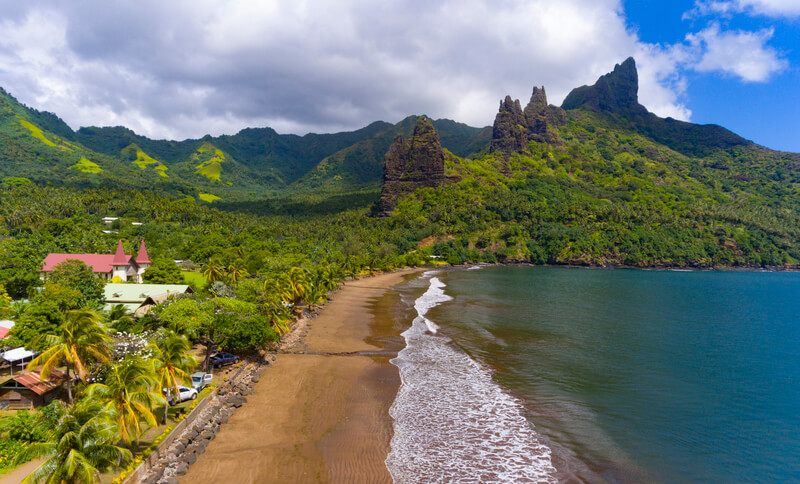
Nuku HivaNuku Hiva (sometimes spelled Nuku-Hiva) is the second largest island in French Polynesia after Tahiti, and the largest in the Marquesas archipelago. Located more than 1,400 km northeast of Papeete, in the northern islands of the archipelago, it has approximately 3,150 inhabitants and serves as the administrative and social heart of the Marquesas. Before exploring its valleys, one must first grasp its outline.
Volcanic area and geography
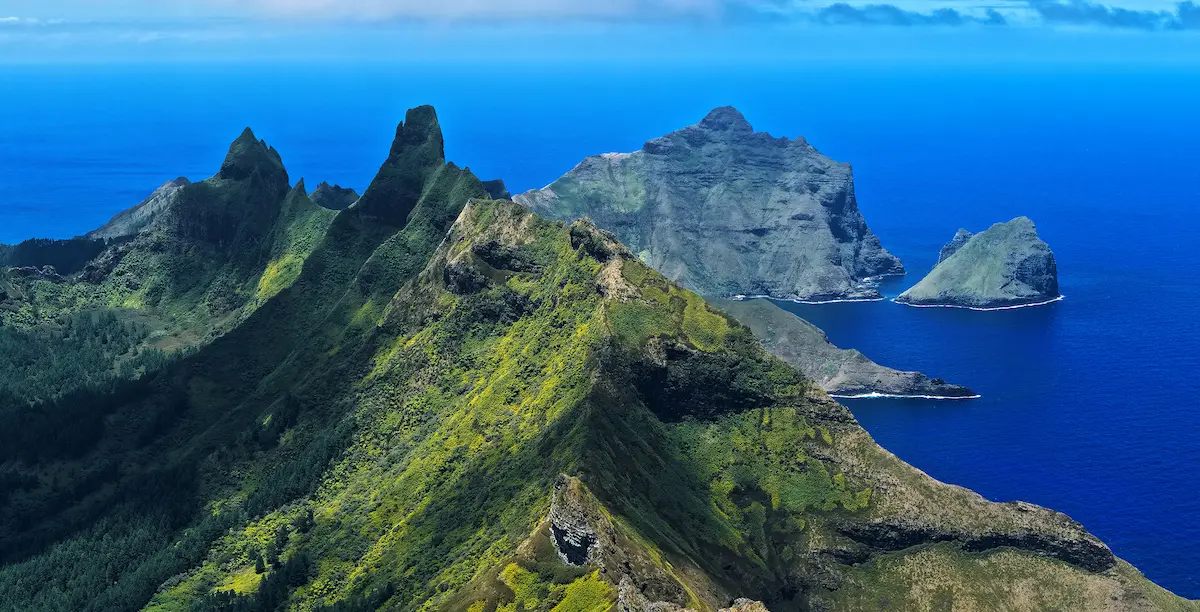
With its 387 km²,the island of Nuku HivaNuku Hiva occupies second place in the ranking of Polynesian islands by size. It is a volcanic island formed from a volcano that has been extinct for approximately two million years.this volcanic islandIt features a rugged landscape, marked by a central caldera, basalt peaks rising to over a thousand meters, deep canyons, and a coastline indented with spectacular bays. The interior alternates between arid plateaus and lush forests, while the slopes plunge abruptly towards the Pacific Ocean. This geology explains the absence of lagoons and barrier reefs: the coasts are directly battered by the ocean swell.
Taiohae, capitale administrative des Marquises
In the south of the island, the vast bay of Taiohae shelters the main village, home to about half of the island's inhabitants. Taiohae is also the administrative center of the Marquesas Islands and, as such, the island's day-to-day capital. It houses the gendarmerie, the hospital, the market, the post office, and several craft shops. Two rocky islets, nicknamed theSentinels of the East and West They mark the entrance to the bay like ancient guardians. Taiohae remains the starting point for most excursions and the port of call for ships.
The spectacular landscapes of Nuku Hiva
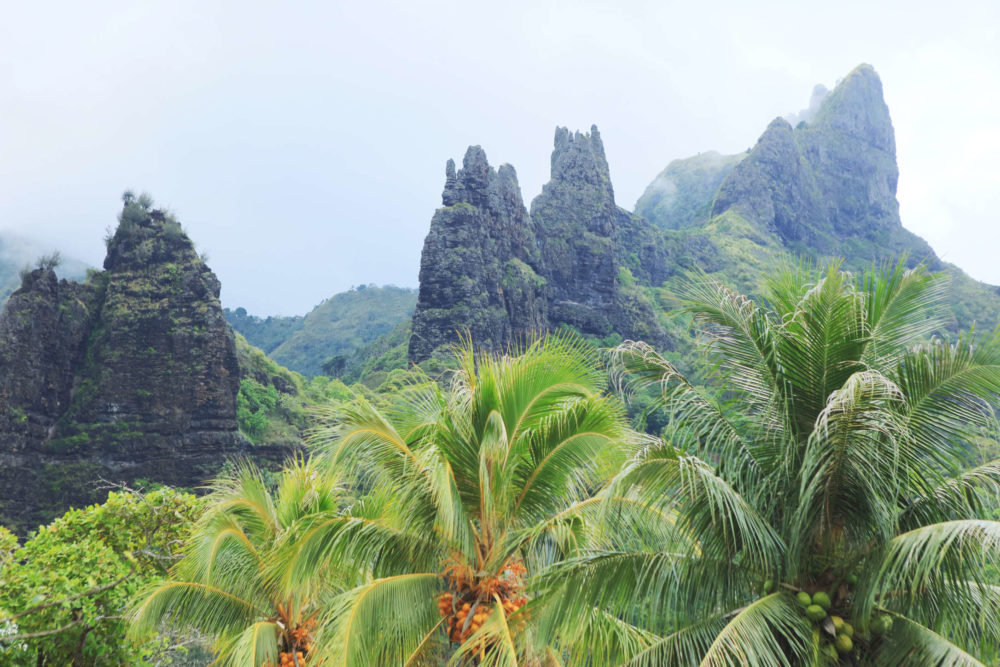
THE landscapes of Nuku Hiva They contrast sharply with the usual Polynesian postcard image. Here, there are no turquoise lagoons or coral islets: the landscape is stark, rugged, almost cinematic. Three locations concentrate the essence of this panorama.
Iconic bays: taiohae, Hatiheu, Anaho
The Taiohae Bay It forms a natural amphitheater bordered by dark green hills. Further north, Hatiheu Bay, dominated by sharp basalt peaks, inspired Robert Louis Stevenson during his visit in 1888. Finally, Anaho Bay, accessible only on foot or by boat from Hatiheu, is considered one of the most beautiful in the Pacific and boasts the rare distinction of a light-colored sand beach in the Marquesas. The other beaches are composed of gray or black sand of volcanic origin.
Vaipo Waterfall and Hakaui Valley
Deep in the Hakaui Valley, nestled between cliffs hundreds of meters high, Vaipo Waterfall plunges approximately 350 meters. It is among the highest waterfalls in the world. Access is by boat from Taiohae, then on foot along a river dotted with petroglyphs and paepae, traditional stone platforms that bear witness to ancient settlement. The hike is long, but the cliffs that frame the route offer a breathtaking geological spectacle that rewards the effort.
Mount Tekao and the interior plateaus
Reaching a height of 1,224 meters, Mount Tekao is the island's highest point, located in the northwest on the ridge that encircles the central caldera. Surrounding it is the Toovii Plateau, a vast grazing area where horses and cows roam semi-freely amidst meadows and pine forests. Further down, the Mount Muake viewpoint (864 meters) offers a breathtaking view of Taiohae Bay, accessible by 4x4 and very popular with visitors.
Villages and valleys to discover on the island of Nuku Hiva
Three villages concentrate the essence of island life: taiohae, Taipivai, and Hatiheu. Each carries its own distinct history and atmosphere. Exploring the island means traveling from one valley to another, crossing mountain passes that reveal a new landscape at every turn.
Taiohae and the Cathedral of Our Lady of the Marquesas Islands
Along the Taiohae seafront, the Notre-Dame Cathedral of the Marquesas Islands It is the most remarkable building in the village. Built between 1973 and 1977 on the site of a former 19th-century church, it is constructed with stones from the six inhabited islands of the archipelago. Its entrance is flanked by statues of Saint Peter and Saint Paul carved from rosewood. Inside, the pulpit and the Stations of the Cross, carved from tamanu wood by Marquesan artists, illustrate the dialogue between Catholic faith and traditional art that still shapes local life. It is the largest church in the Marquesas Islands.
Taipivai, Herman Melville's valley
About thirty minutes by 4x4 from Taiohae, the Taipivai Valley entered literary history thanks to Herman Melville. On July 9, 1842, the future author of Moby-Dick deserted his whaling ship, the Acushnet, which was docked in Taiohae, and walked to the valley where the Taipi tribe lived. He stayed there for about three weeks.Nuku Hiva From this experience came Typee (Taïpi in French), his first novel, published in 1846 and his greatest commercial success during his lifetime. The present-day village, nestled on the banks of a river, retains a rural atmosphere and several major archaeological sites nearby.
Hatiheu, archaeological cradle
In the north, the Hatiheu Valley boasts the highest concentration of cultural sites on the island. The village, bordered by a black sand beach and dominated by basalt spires, has undergone significant restoration work to preserve its archaeological heritage. It is accessed via a spectacular ridge road from Taiohae that winds through plateaus and forests before descending to the bay.
Archaeological sites and Marquesan cultural heritage
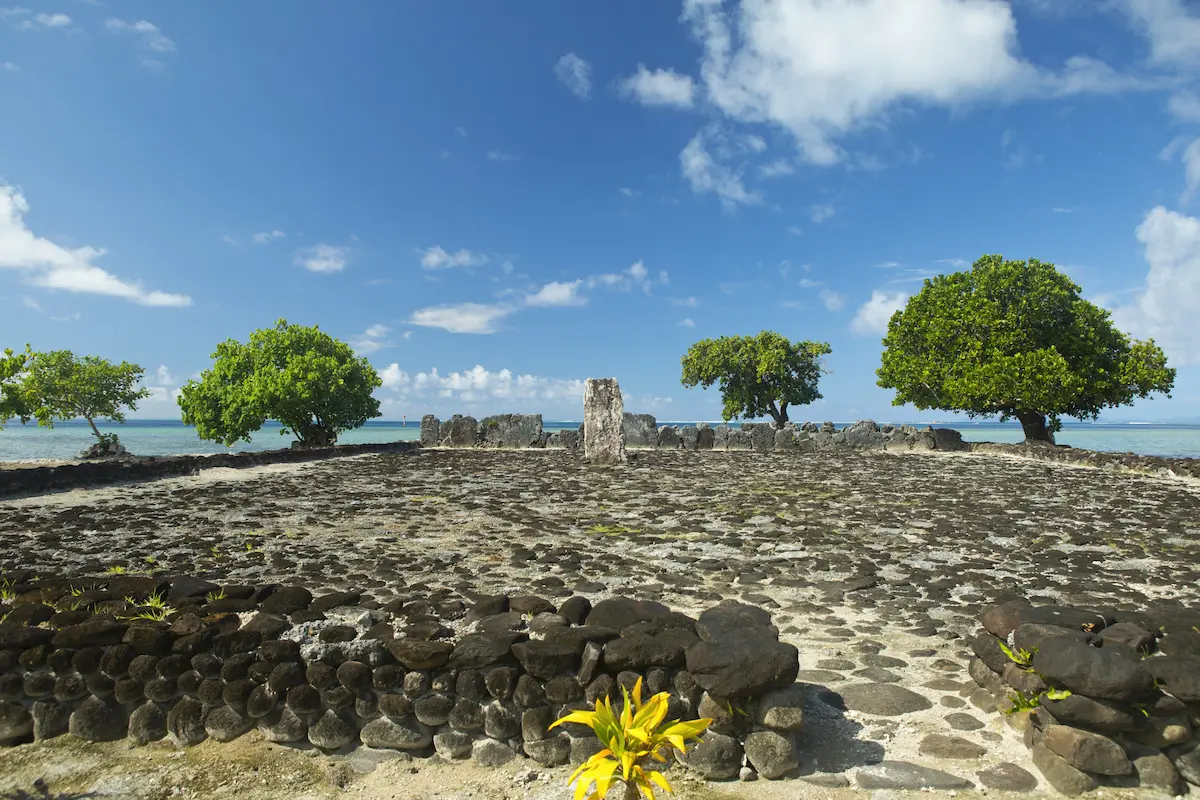
In July 2024, the Marquesas Islands were listed as a UNESCO World Heritage Site.UNESCO World Heritage under the official name Te Henua Enata, the Land of Men, as a mixed property according to both natural and cultural criteria. This recognition celebrates decades of commitment by the Marquesans to protect a heritage passed down for nearly a millennium. Nuku Hiva concentrates some of the most important archaeological sites of this inscription: tohua, paepae, me'ae and tiki comprise a rich heritage.
Tohua Koueva in Taiohae
Nestled in the Haavao Valley, overlooking Taiohae, the Koueva tohua was restored to host the Marquesas Festival in 1999. This vast ceremonial space is said to have belonged to the war chief Pakoko, a figure of the Marquesan resistance killed by the French in 1845. Petroglyphs, platforms and large traditional trees make up a remarkable ensemble, just a few minutes from the center of the village.
Tohua Hikokua and Kamuihei in the Hatiheu Valley
Discovered by the American archaeologist Robert Suggs in 1957, the Hikokua tohua dates back to around 1250 AD. Its rectangular esplanade, flanked by steps made of basalt blocks, once hosted community festivals and ritual dances. A few hundred meters away, the Kamuihei site impresses with its gigantic sacred banyan tree and petroglyphs carved in volcanic rock, evidence of a particularly dense ancient settlement.
The site of Paeke in Taipivai
Just outside Taipivai, on the road to Hatiheu, the Paeke site stretches along the hillside. Its stone platforms shelter several red tuff tiki, some of which are among the best preserved in the Marquesas Islands. Access is on foot from the road, a 30-minute walk through tropical vegetation.
Things to do in Nuku Hiva: activities and experiences
The island isn't meant to be rushed. Its rugged landscapes dictate a pace, and activities revolve more around hiking, off-roading, and meeting new people than traditional water sports. Here's a glimpse of what awaits visitors.
Horseback riding and hiking
The trails of the largest island of the Marquesas. The trails traverse endemic forests, panoramic ridges, and remote valleys. The hike to Vaipo Falls remains the most famous, but other routes, such as the Aakapa-Hatiheu traverse or the Teivipakeka ridge, offer exceptional views. Horses, ubiquitous in local culture, also allow for exploration of the interior plateaus and secondary valleys.
4x4 excursions on the mountain ridges
The road linking Taiohae to Hatiheu crosses passes at over 800 meters altitude and is an experience in itself. 4x4 excursions allow you tovisitor Nuku HivaFrom one valley to another in a single day, with stops at archaeological sites and a traditional lunch with a local family in Hatiheu. The spectacle of the basalt ridges, punctuated by encounters with wild horses and goats, is reason enough to make the trip.
Marquesan crafts: sculpture and tattooing
The Marquesas Islands are renowned for their wood, bone, and stone carving. In Taiohae, the craft center near the jetty showcases local products: tiki, umete (ceremonial dishes), and jewelry made from mother-of-pearl and seeds. Marquesan tattooing, an ancestral art revived since the 1980s, also attracts many visitors seeking authentic designs passed down from master to master.
When to go to Nuku Hiva: climate and best season
The Marquesas Islands enjoy a unique tropical climate, drier and more unpredictable than that of the Society Islands. Choosing the right time to visit avoids unpleasant experiences and maximizes your chances of exploring the islands in optimal conditions.
Dry season and wet season
The wet season extends from January to March, with average temperatures around 28°C and concentrated rainfall that can make some roads impassable. The dry season runs from May to October, with clearer skies, slightly milder temperatures, and generally calmer seas. April and November serve as transitional seasons.
The best time to travel to Nuku Hiva
The ideal time for a trip to Nuku Hiva. The season runs from May to October. Hiking trails are accessible, the light is exceptional for photography, and sea crossings are more comfortable. Note: the Marquesas Islands are not exposed to cyclones, unlike some other Polynesian archipelagos. To refine your travel plans, consult our guide. when to go to French Polynesia.
How to get to Nuku Hiva
Located more than 1,400 km northeast of Tahiti, Nuku Hiva remains a remote destination. Two modes of access exist: by plane from Papeete, and by sea aboard the Aranui. Each offers a very different travel experience.
By air: nuku Ataha airfield
L'Nuku Hiva AirfieldNuku Ataha (Desert Land), also known as Nuku Ataha, is located in the northwest of the island, about a 1.5-hour drive from Taiohae. Air Tahiti and Air Moana, which entered the market in 2023, offer regular flights from Papeete, with a direct flight time of approximately 3 hours and 15 minutes. The airport-village transfer, while long, is spectacular, crossing arid plateaus and basalt ridges. This should be factored into your calculations of the actual time you'll spend on the island.
|
Criteria |
Plane |
Aranui Cruise |
|
Duration Papeete-Nuku Hiva |
3 hours 15 minutes flight + 1 hour 30 minutes transfer |
~2 days at sea |
|
On-site accommodation |
To reserve |
On board the ship |
|
Number of islands visited |
1 (except Marquesas pass) |
Up to 9 islands across 3 archipelagos |
|
Experience |
Self-guided land stay |
Immersion cargo-mixte |
By sea: the Aranui cruise from Papeete
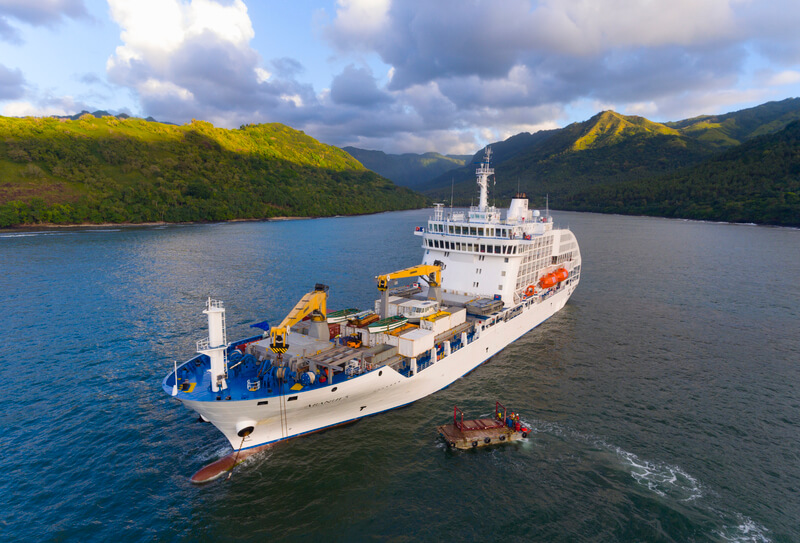
Since 1984, the Aranui has connected Tahiti to the Marquesas Islands with its fleet of mixed cargo and passenger ships. The Aranui 5, in service since 2015, calls at Nuku Hiva on every voyage, generally twice per itinerary. Stopovers in Taiohae last from 3 to 5 hours, punctuated by cargo operations. This mode of access immerses passengers in the economic reality of the archipelago: the ship is not just a means of transport, it is the vital link that supplies Tahiti with goods and collects its produce, including copra. It should be noted that the Aranui 5 does not have stabilizers: in heavy swells, rolling can be noticeable. Find all the cruises to the Marquesas Islands available.
Practical information to help you prepare for your trip to Nuku Hiva
Before leaving, a few practical considerations can help avoid unpleasant surprises. Accommodation, internet access, equipment: the island requires a minimum of planning.
Accommodation: guesthouses and Nuku Hiva by Pearl Resorts
For astay in Nuku HivaBy land, accommodation options remain limited. Several guesthouses, located in Taiohae, Taipivai, and Hatiheu, offer an authentic experience with traditional meals included. The Nuku Hiva by Pearl Resorts, the island's only superior lodge, offers bungalows in the hills above Taiohae overlooking the bay. Passengers on aAranui cruise. They, however, sleep on board the ship throughout the entire voyage.
Internet connection and daily life
Since December 2018, Nuku Hiva has been connected to the Natitua submarine cable, which brings fiber optic internet to Taiohae and 4G mobile network coverage to the main villages. However, coverage remains patchy in remote valleys. The cost of living, due to imports and Polynesian taxes, is significantly higher than in mainland France: some imported goods are taxed at up to 160%. Plan an appropriate budget for local purchases.
What to pack in your luggage
A volcanic and hilly island calls for versatile equipment. Here are the essentials to pack :
- Lightweight clothing (shorts, t-shirts, swimsuits) is recommended for the warm weather.
- Sturdy walking shoes for hiking and archaeological sites
- Water shoes for rocky platforms
- Effective mosquito repellent: the local midges, known as no-no, are particularly tenacious.
- High protection sunscreen is essential, as UV exposure is high at this latitude.
- Lightweight jacket for evenings at altitude or sea crossings
- Dress slightly smartly for meals on board or in guesthouses
Nuku Hiva, a journey to the end of the Pacific
Few islands combine such mineral intensity, such cultural depth, and such remoteness. Visiting Nuku Hiva requires accepting the need to slow down, to listen, to walk. It also means understanding what the passage of a cargo ship connecting the island to the rest of the world represents for the inhabitants. For those considering an off-the-beaten-path stay in Polynesia, the Aranui offers the opportunity to...discover Nuku Hiva in a wider journey across the Marquesas archipelago, from Ua Pou to Hiva Oa, following in the footsteps of the Land of Men now recognized by UNESCO.
Fancy exploring the Polynesian archipelagos at the pace of a mixed cargo-passenger ship? Discover all our itineraries :
- Bora Bora Cruise
- Tahiti Cruise
- Marquesas Islands Cruises
- Austral Islands Cruise
- Cook Islands Cruise
- Pitcairn Island Cruise
- Society Islands Cruise
- Tuamotu Islands Cruise
- Gambier Islands Cruise
FAQ
How long is the flight from Tahiti to Nuku Hiva ?
The direct flight between Papeete and Nuku Ataha Airport takes approximately 3 hours and 15 minutes. Several flights are operated weekly by Air Tahiti and, since 2023, by Air Moana. Depending on the route, some flights stop over in Hiva Oa, which adds approximately 4 hours and 30 minutes to the total travel time. The transfer from the airport to Taiohae then takes 1 hour and 30 minutes; you can arrange this transfer with your accommodation or a local transport provider.
Are there sandy beaches in Nuku Hiva ?
Yes, but they don't fit the typical image of tropical white sand. The beaches are mostly made up of gray or black sand of volcanic origin, like those of Taiohae or Hatiheu. Only Anaho Bay, accessible from Hatiheu, has a beach with lighter sand. The island has no lagoon: swimming in the sea is possible but exposed to the Pacific swell.
Is it possible to go snorkeling in Nuku Hiva ?
The Marquesas Islands lack a barrier reef and lagoon, severely limiting snorkeling and recreational diving opportunities. The waters are deep right from the shore, and visibility varies with the swell. To explore the coral reefs of French Polynesia, you must look to other archipelagos, particularly the Tuamotuand their atolls of Fakarava and Rangiroa, renowned for their underwater biodiversity.
What is the difference between Nuku Hiva and Hiva Oa ?
Nuku Hiva, in the north of the archipelago, is the largest island and home to the administrative capital in Taiohae. Hiva Oa, in the south, is slightly smaller but contains the graves of painter Paul Gauguin and singer Jacques Brel at the Atuona cemetery, making it a must-see for art and literature enthusiasts. Both islands offer comparable volcanic landscapes, but Hiva Oa boasts a particularly high concentration of major archaeological sites, notably the large tiki at the Iipona site.
Is Marquesan still spoken in Nuku Hiva ?
Yes. Marquesan, recognized as a regional language of France, remains alive on the island, spoken in homes and during ceremonies. There are two dialectal variants corresponding to the two island groups: the northern dialect (ènana), spoken on Nuku Hiva, Ua Pou, and Ua Huka, and the southern dialect (ènata), spoken on Hiva Oa, Tahuata, and Fatu Hiva. Revitalization efforts are being carried out by schools and the Marquesan Academy, established in 2000 by the Assembly of French Polynesia.
Read also